
Book Review: The Infinity Machine
The past, present, and future of Google DeepMind

The Infinity Machine, by Sebastian Mallaby, has three protagonists.
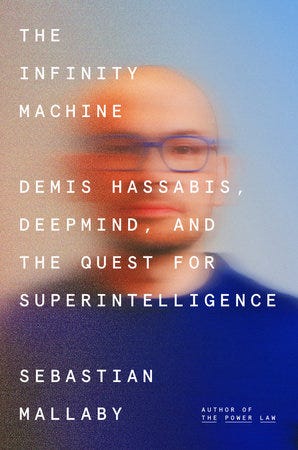
There’s Demis Hassabis, a lover of games. He loves making games, he loves playing games, but most of all he likes winning games. Geoffrey Hinton called him the most competitive person he’d ever met1.
Next there’s Demis Hassabis, a scientist. This is a man who cares about understanding nature, and building tools that further that understanding.
There’s also Demis Hassabis, a visionary. A man with a mission to use his gifts for the betterment of all.
This is the story of how those three men built DeepMind and sparked the modern era of artificial intelligence.
The Rise of Demis Hassabis
The first character we meet is Demis Hassabis, gamer. At age six, he discovered a talent for chess. Or, more precisely, chess discovered him. After watching him play, a renowned chess master told the Hassabis parents that six-year-old Demis was the best young player he’d ever seen. The family immediately reoriented itself around chess. His father always told him he’d be proud of Demis as long as he tried his hardest. To most of us, that sounds like a reassuring bit of parental support. To Demis, that meant that if you still had the energy to stand up at the end of the tournament, you were screwing around.
Demis climbed through the ranks of young chess players. The turning point came when he was twelve, at a tournament in Liechtenstein. After resigning a grueling game, Demis looked around the room. It was full of brilliant people, all spending their brainpower on the game of chess. A young Demis realized they were wasting their time. It was at that moment that he decided… to get really good at a wider variety of board games.
As his love of games matured, it stopped being enough to just play them. Teenaged Demis joined a game studio, working on the 90s-era artificial intelligence of non-player characters. After college, he founded his own games studio: Elixir. He recruited his classmate: a crack programmer named David Silver. And, together, they set out to make the most sophisticated video game in history: a political simulation game called Republic: The Revolution.
Their ambitions grew loftier and loftier. The game would have hundreds of NPCs, each with their own personality. Hype began to build. It was named the most anticipated game in the world. That proved prophetic: fans would spend years anticipating as the delays mounted. No amount of engineering genius could fit Demis’ vision onto the hardware of the time. David Silver spent sleepless nights trying to get enough of the game ready for demos. But even then the Elixir team was forced to cheat: running the game on souped-up machines with multiple processors (later, under Demis’ leadership, GDM would again be caught overpromising and fiddling with demos. The author of The Infinity Machine refuses to make that connection). When a pared down version of Republic came out, it was a disappointment. A burnt-out Silver quit.
Soon after, the company folded. In a strange twist of fate Demis and Silver found themselves on the same track once again: PhD programs, studying the young field of artificial intelligence.
The Rise of DeepMind
So far, this has been a biography of Gamer Demis. It’s unclear exactly when Science Demis entered the scene. Perhaps the seeds were planted in that chess hall in Liechtenstein. I think we may have met him during the college years. But he doesn’t become a protagonist until after the fall of Elixir Studios.
His experiences as a programmer had convinced Demis that the orderly rules he programmed into his NPCs couldn’t possibly be the route to powerful AI. So during grad school, Demis became a student of neuroscience. He studied the messy, flawed mechanisms that powered the human brain.
It was around this time that Demis first read Ender’s Game. The book is about a child prodigy who builds a team of strategic geniuses and saves the world. Doubtless, Gamer Demis found something to enjoy in that book. But it was even more meaningful to Demis the Visionary.
By the end of the PhD, Demis the Scientist and Demis the Visionary had landed upon a new ambition: building Artificial General Intelligence. It would be an infinity machine: infinite knowledge, infinite power, infinite money. Not only would this solve all of science, but it would solve all of medicine, end poverty, perhaps even put an end to all wars.
To do this, Demis would need a supporting team of people who weren’t named Demis Hassabis. David Silver was still feeling burned by Elixir, so Demis turned to a fellow scientist-visionary named Shane Legg.

Whatever oddball opinions Demis had about AI, Legg’s were odder and ballsier. He popularized the term Artificial General Intelligence. He was Demis’ link to a new scene. People like Ray Kurzweil and Marcus Hutter and Eliezer Yudkowsky. The scene that would one day include not only DeepMind, not just OpenAI and Anthropic and SpaceX but also MIRI and ARC and this blog.
They rounded out the team with Mustafa Suleyman. He was a different sort of visionary: while Legg talked about radical life extension and Demis dreamed of solving protein folding, Suleyman would talk to actual nurses and find that they really just needed better pagers.
This was the team that would inaugurate the AI race. And in an industry that values contrarian decisions, they made the most contrarian decision possible. Instead of working in the heart of Silicon Valley, they would locate DeepMind in a quaint little town called London, England. Now, you might have heard that London is a city of ten million people, and a global financial center. But to hear Mallaby (who is English) tell it, they might as well have been setting up shop in Kathmandu.
So Demis and Legg went to America to find seed capital. Legg brought them to the Singularity Summit, a convention for believers. There, Shane introduced Demis to Eliezer Yudkowsky. Eliezer introduced the pair to Peter Thiel. DeepMind had an investor.
With funding secured, the founders got to work. They began training AIs on increasingly complex tasks. The first turning point was 2012. While my generation thinks the history of AI began with ChatGPT, the current march of triumphs actually began with an image recognition program called AlexNet, trained by Geoffrey Hinton’s lab at University of Toronto. AlexNet used a then-obscure technology called a neural network, and for some reason they had trained it using Graphics Processing Units. Very quickly, everyone grew very familiar with those techniques.
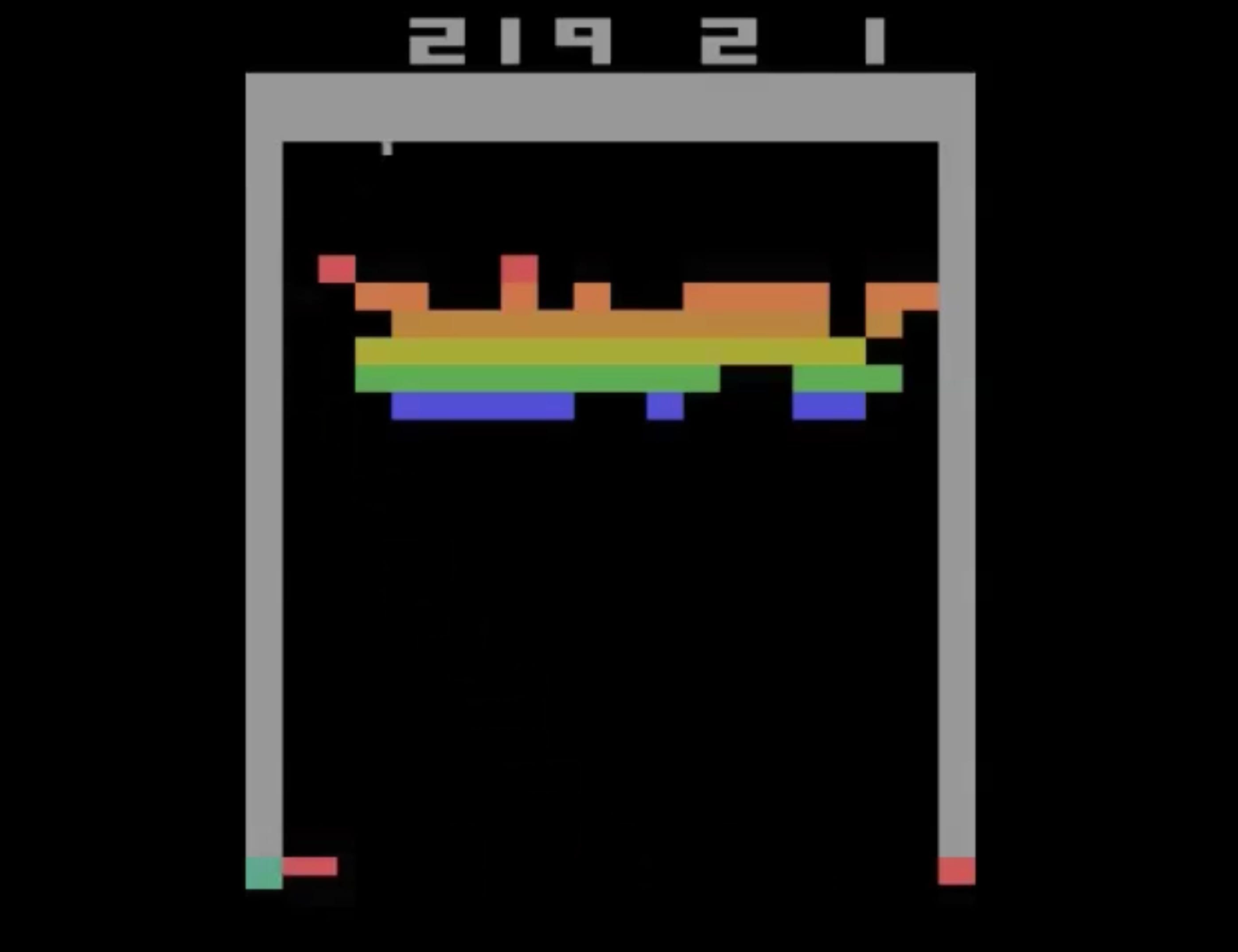
At the same time that AlexNet was setting off a race to acquire AI talent, DeepMind was locking some down. The new team needed a fitting challenge, something far beyond mere image recognition. Fittingly for a company founded by a gaming champion, they settled on Atari. The DeepMind team used reinforcement learning to teach neural networks to play the entire suite of Atari games. They managed a few of the easier ones, but to finish the challenge they would need the help of a master of RL. In Demis’ old friend David Silver, they found one. In December 2013, a crowd at NeurIPS2 watched as DeepMind’s machine played Breakout. The Atari Challenge was complete.
Go Time
DeepMind had a fast-growing staff in a fast-growing field that demanded fast-growing salaries. They needed to raise money. Thiel couldn’t (or wouldn’t) give them the capital they needed. And London’s VC scene certainly couldn’t be expected to help. Demis was spending half his time shopping DeepMind around in California. It wasn’t a game, it wasn’t science, it certainly wasn’t visionary. He hated it. He realized he would need to sell DeepMind.
The buyer would need deep pockets. But if they were buying a potential infinity machine, they would also need a deep sense of mission. There was someone who fit that bill: Thiel’s friend Elon Musk.
But Musk, as you may have heard, is not a very discreet man. Though he owned only a small stake in the company, he bragged about it to Larry Page, thus putting DeepMind on Google’s radar. The result was a bidding war that only Google could win.
But though Demis was selling the company, he wasn’t ready to give up control to a large corporation. He didn’t fully trust Google with what might be the most powerful technology in history. He also didn’t trust an organization of that size to make good and nimble decisions.
So Demis bargained for autonomy, not just money. He would set up an oversight committee that, he hoped, would ensure that AI was deployed in an ethical and safe way. In order to head off hard feelings, he even invited Elon to sit on that committee. The Infinity Machine tells the story of a tense oversight meeting hosted at SpaceX.
With the benefit of hindsight, I think it’s safe to call that plan a complete failure. Today, there is no oversight committee, DeepMind has been completely absorbed by Google, and they’re selling military technology to the government. Their group is at best a distant third in the race to AI. But you don’t need 2026 vision to see that the oversight committee failed. You can just look to 2015, when Elon Musk founded a rival company. Google couldn’t be trusted with an infinity machine. Instead, he found a nice, honest, candid person named Sam Altman to supervise the race to superintelligence.
This was the point when the race to AI truly became a race. Demis the Scientist and his quirky band of Europeans, versus Sam Altman, the man from the heart of Silicon Valley. For a time, DeepMind was winning. Their first great success was AlphaGo. This was a neural network trained on the ancient board game of Go. Earlier iterations were trained based on studying human games, but the final version, dubbed AlphaGo Zero, reached far superhuman levels based on millions of games played with itself. Gamer Demis was thrilled.
Next, it was a pet project for Demis the Scientist. AlphaFold was a very different sort of project. The goal was to solve the protein folding problem: given the sequences of amino acids that made up a protein, determine the structure they form in 3D space. Because determining protein structure was so difficult, the scientific community only had a few hundred thousand structures, not enough for conventional machine learning. And this wasn’t a simple game where you could make your own data with self-play.
DeepMind’s strategy was brilliant. Determining the 3D structure of a protein is expensive and time-consuming. But reading the raw amino acid sequence is cheap. DeepMind got access to a database of billions of raw amino acid sequences found in nature. They found a huge amount of redundancy; lots of pairs of proteins performing similar functions in closely related organisms. What they realized was that although the mutations were scattered all around the protein sequence, they would be located in just a few places in 3D space. The large database plus evolution give a hint at 3D structure. The DeepMind team fed a protein, plus its close evolutionary cousins, into a new type of neural network: the transformer, recently developed by Google. The result was an incredible breakthrough in medical science.
As AlphaFold and AlphaFold 2 proved the power of big data and transformers in science, another group at DeepMind was showing the same thing in the language setting. They put out Chinchilla, a family of models of different sizes trained on increasing amounts of data. The result was clear: more size and more data meant better performance. Good news for the company sitting on more data and more chips than any other.
The Chatbot Era
Looking at the historical record, it’s clear OpenAI had no idea how big ChatGPT would be. They were a team of visionaries. They foresaw that AI would change the world. They could tell that scaling up language models was the way of the future. But they had no idea that their fun little app would be the greatest triumph in their race with DeepMind.
If OpenAI was surprised by their own success, Google was downright unprepared. Google and DeepMind had produced language models, but they had never been central to the strategy the way they were at OpenAI or Anthropic3. In the months after the ChatGPT moment, Google rushed out its own chatbot: Bard. Google managed to be both too slow and too fast: too slow in that three months is a long time in the world of AI, and too fast in that the product they put out was unreliable and downright annoying. It’s telling that more than three years later, the AI overview descended from Bard is probably still the most embarrassing technology in the field of AI.
What’s worse, Google had a serious talent problem. Geoffrey Hinton quit over ethical concerns. The discoverers of the transformer had walked out the door. With the brains behind Google Brain pouring out, Google turned to DeepMind. They merged it with what was left of Google Brain, creating Google DeepMind under Demis Hassabis. It was only then that they realized they’d lost their most valuable employee. Demis the Scientist had no interest in LLMs.
Making better and better language models was just a matter of throwing together ever larger bags of tricks at ever larger scales. It wasn’t a science project. And though a competitive man like Demis the Gamer didn’t like losing to OpenAI and Anthropic, he didn’t like playing the same game for three years straight either. Gemini, the successor to Bard, managed to compete with ChatGPT. Sometimes it was ahead, but there were more missteps than great strides. Today, Google’s most powerful model is Gemini 3.1 Pro, a product they released six months ago. It’s been surpassed by offerings not just from OpenAI and Anthropic, but also SpaceX and Meta and DeepSeek and Alibaba and Z.ai and MoonShot.
Last week, Google’s talent exodus continued. Demis Hassabis stepped back from running DeepMind, saying he would focus on medical applications of AI.
The Future
The reason for Demis’ fall is clear: as the other labs focused on language models (with an occasional side project in image generation) he kept his team focused on a wider array of bets: weather prediction and automated theorem-proving and video and text diffusion. Over the past few years, these bets have not paid off.
I don’t blame Scientist Demis. As a scientist, I think figuring out text diffusion and climate sounds a lot more interesting than scaling up language model pretraining yet again. But, beyond viewing GDM as a playhouse for Demis the Scientist, do I agree with the strategic choices he was making? The current paradigm (train a transformer on next-token prediction, then do reinforcement learning for capabilities and alignment) is between six and two years old depending on how you count it. There’s a very real chance that before we reach AGI there will be one or more paradigm shifts, and Demis was extremely reasonable to chase after them.
Of course, Google is a large organization, dozens of times larger than OpenAI and Anthropic put together. Even restricting to Google DeepMind leaves an organization several times larger than Anthropic. Why couldn’t it engineer the next generation of LLMs even while searching for the next big paradigm? The author of The Infinity Machine claims it’s organizational incompetence. Google was too large, it had too many internal power struggles and too much risk aversion and somehow also too much aggressive need to get to market.
I want to push back on this narrative. Google did incredible work, both in and out of DeepMind. They invented transformers, TensorFlow, and TPUs. They recruited a huge amount of incredible talent, including Geoffrey Hinton and Fei-Fei Li. Whatever the story is, it has to be more complicated than the ‘Google dumb, Demis smart’ narrative this book tries to sell.
So if the failure isn’t Google’s fault, and I’m not blaming Demis’s science instincts, why is Google so far behind? I think the answer is simple: Demis the Visionary fucked it up.
Throughout the story, Demis the Visionary is constantly telling people that he’s working on an infinity machine, a superintelligence that will change life on Earth. But he’s never able to convince the rest of DeepMind or Google. Mustafa Suleyman was never a believer in that sort of thing. Shane Legg was a believer long before he met Demis. And Demis never acts like he believes the singularity is near. If he did, he would have invested in automated coding assistants more than quantum chemistry. He wouldn’t be caught flat-footed every time the public needed a message. He certainly wouldn’t be spending DeepMind’s efforts and political capital on hospital pagers. The fact of the matter is that Demis the Visionary wasn’t visionary enough.
Or, to put it in terms he would understand, he failed to learn the lessons of Ender’s Game. Demis is an endlessly energetic genius, always willing to ‘try his best.’ But the failure of Elixir Studios should have taught him that not everybody has that. If he’d paid more attention to the second half of Ender’s Game, he would have seen the titular child genius managing his team of prodigies through ordeal after ordeal. He would have read how Ender tried and sometimes failed to keep them energized and on task. If Demis the Visionary had read more closely, he would have learned that nobody saves the world without a talented team committed to the same vision. He also would have learned that selling that vision wasn’t a one-time job, it happened again and again after every battle4.
Now he’s gone, and GDM is even more bereft of visionary leadership. Perhaps someone new will emerge to take that role. But my honest guess is that Google DeepMind will continue its slow slide into irrelevance. The Infinity Machine, which came out just before Demis’ departure, will forever be the story of someone who couldn’t make his vision a reality.
The full quote is more interesting: “Demis is the only person I’ve ever met who’s more competitive than me.” I was completely unaware of that side of Geoffrey Hinton.
The largest machine learning conference. At the time, it was called NIPS.
In the course of researching for this review, I learned that every model Anthropic has ever released has been a language model, a distinction none of the other major labs share.
He also would have learned that assembling a good team doesn’t matter, you can just forge whoever fate hands you into a genius. Here’s hoping no AI lab leaders ever read Ender’s Shadow.