
Fine-Tuning, The Hierarchy Problem, and What Neutrons Tell Us About God
How close is too close?
Sometimes in science, in math, in life, you find coincidences you can’t explain.
Put yourself in the shoes of a 19th-century scientist. A chemist, to be precise. You know from experiments in faraway Paris that when hydrogen reacts with oxygen, it always does so in a 2:1 ratio, as near as anyone can measure. Why 2 instead of 1.87? And this isn’t the only suspicious whole number your experiments have turned up. The two oxides of carbon (what we now call carbon monoxide and carbon dioxide) take oxygen in a 1:2 ratio. The three salts formed by potash and oxalic acid take the acid in a 1:2:4 ratio. And so on. You realize this could be explained if chemical reactions were about indivisible components of matter interacting in specific configurations. You’ve just discovered the atom1.
Another example: The sun has about 400 times the diameter of the moon, and is about 400 times further away, meaning it usually appears the same size in the sky, up to a few percent. This is why solar eclipses look so awesome: if the moon were a bit further away, we’d just see a bright star getting 90% dimmer (which is hard to even notice). If it were closer, we wouldn’t see the photosphere peeking out.
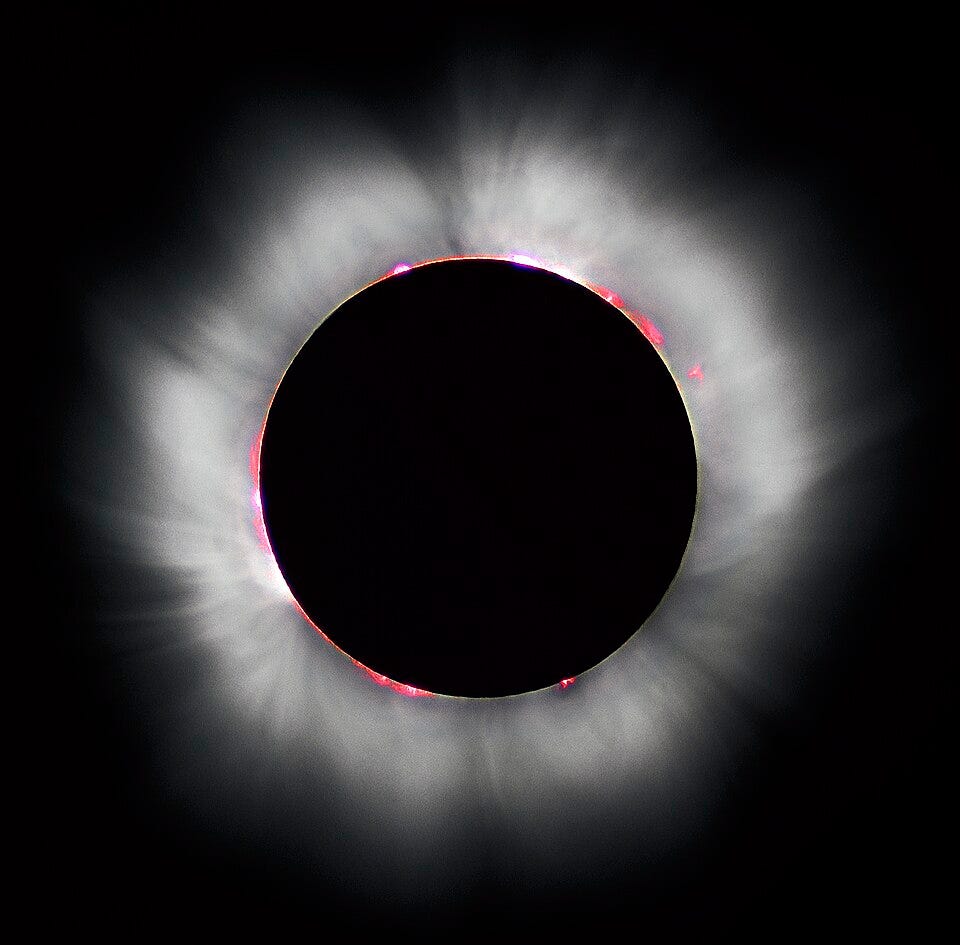
This, as far as current science knows, is just a spurious coincidence. Indeed, it’s not a permanent fact of the universe: the moon used to be much closer to Earth than it is now.
What about in math? As someone whose day job occasionally involves studying the best mathematical coincidences, there’s a clear winner: 196884=196883+1.
Let’s unpack that. 196883 is the dimension of the smallest faithful representation of the Monster Group. 196884 is a term in the Laurent expansion of a modular form called the j-invariant. If that sounds like gibberish to you, don’t worry, just know that it’s two completely different areas of math. In 1978, a mathematician named John McKay noticed this coincidence (and then a tower of other coincidences relating to the group’s other representations). Upon further investigation, he found that Andrew Ogg had noticed another connection between number theory and the prime factors of the size of the Monster, offering a bottle of Jack Daniel’s Whiskey to whoever explained the connection. These discoveries set off a flurry of work on the ‘Monstrous Moonshine’ phenomenon, culminating in a proof using ideas from string theory.
This is the clearest example of a coincidence nobody expected, nobody was looking for. It’s proof that if you notice a cool enough coincidence and stick to it, you could win a Fields Medal, or at least a bottle of liquor.
What about in economics? At the time that I write this, the total dollar value of all companies on the Qatar Stock Exchange is 169.24 billion. In neighboring Kuwait, it’s 168.8 billion, a difference of just 0.2%. If that doesn’t impress you, India’s Bombay Stock Exchange and National Stock Exchange agree right now to within 0.08%.
The Indian coincidence has a simple explanation: the two exchanges have almost the same list of companies. For Qatar-Kuwait, I just asked Claude to run through a list of stock exchanges until it found two that were similar.
What Makes a Compelling Coincidence?
There are two criteria that make a coincidence worth thinking about: whether it points to a true connection instead of a spurious correlation, and whether the true connection is subjectively interesting or a snoozefest. We can make a 2-by-2 table
So what separates the subfield-defining depth of the Moonshine coincidence from the silly numerology of the sun and the moon? It isn’t really a matter of plausibility to onlookers; the name Monstrous Moonshine wasn’t chosen because the conjecture seemed tame and reasonable. The clearest thing separating them is the size of the coincidence. The initial coincidence that gave rise to Moonshine has 6 digits, with many more once you start looking at the larger representations. So should we just be on the hunt for more digits?
Well, here’s another coincidence. The price I paid for a bagel earlier today divided by the market cap of Nvidia is equal to zero, down to one part in a trillion2. Perhaps you’re not impressed. You already know ‘some things are much bigger than other things.’ What about these:
The mass of our solar system equals the mass of the sun to three significant digits
The time it took intelligent life to evolve on Earth equals the time it took advanced civilization to develop, to about four significant digits
Either of these can be thought of either as a BSE-NSE type non-spurious coincidence, or as a bullshit example I concocted by adding a small thing to a big thing and noticing it didn’t change very much. You might think you know how to tell those two things apart. Well, try to hold onto that feeling while we talk about the hierarchy problem.
Fundamental Physics Isn’t So Fundamental
At some point in your life, someone you trusted told you that a proton was made out of three quarks. It's not. A proton is a roiling sea of quarks, antiquarks, gluons, and even a few photons. Some have positive mass, and by the vagaries of quantum physics, some have negative mass. It might be more accurate to say that a proton has 500 quarks and 497 antiquarks.
You may have been taught that an electron was a fundamental particle, at least in the standard model. That, too, was a useful fiction. In the seething stillness of quantum field theory, an electron is constantly throwing off photons, which throw off electrons and positrons and quarks and muons, in a complicated cloud that darkens the lives of first-year grad students around the world. Things like the mass and charge of the electron are situation-dependent. The higher the energy and smaller the distance you study, the closer you get to the center of the cloud, and the more violent things become. The core of the cloud is, we suspect, made of quantum gravity-scale positive masses and quantum gravity-scale negative masses. It all cancels out to about 10-27 grams. Since the mass scale of quantum gravity (often called the Planck mass) is about 2*10-5 grams3, it’s a cancellation down to about one part in 1022, one of the most insane coincidences we’ve seen so far.
Do we understand the mechanism for this scientific coincidence? Yes. For a spin-1/2 particle like the electron, a phenomenon called chiral symmetry makes this sort of cancellation natural. For a spin-1 particle like the Z boson, a gauge symmetry protects the low mass. But there is one known particle where we don’t have any definitive explanation: the spinless Higgs boson. Why do the positive and negative contributions cancel out so perfectly? Why is its mass 1017 times smaller than the Planck mass4? Should we view this with the same amount of shock as if the radii of two galaxies agreed down to the size of an atomic nuclear?
This question is usually called the hierarchy problem in physics (often lumped with the equally thorny problem of why the cosmological constant- the mass of the vacuum- is so small, an even more extreme cancellation, with even fewer proposed explanations). My guess is that there is a satisfying technical explanation. One day someone will point out some symmetry of a theory we don’t even know yet, and future scientists will agree this makes just as much sense as Monstrous Moonshine and the mass of the electron. Even that might be too pessimistic; there are already plenty of candidate theories that explain the hierarchy problem- maybe it’s one of them. But what if it isn’t? What if some fundamental parameter of our universe was just tuned to 34 digits to make the Higgs boson light?
Maybe God Cares A Lot About The Neutron Dipole Moment
The fact that the Higgs mass is so much smaller than the Planck mass, and the mass of the vacuum is far less still, is necessary for the universe to have life as we understand it, with an enormous universe and big planets and small atoms. If you’ve read a small enough amount of science fiction, you might even think this hierarchy is necessary for any life at all. Perhaps, the argument goes, it isn’t a coincidence that we live in a universe that can support large amounts of life. We are life. We don’t need to reason about weird symmetries in quantum field theories to know that we exist. This is usually called the anthropic argument, and is used to explain why our universe is fine-tuned to our existence. Some people go even further, suggesting that the fact that the universe is so (seemingly) improbably fit for life means someone or something made it that way. Thus, the smallness of the Higgs mass is evidence for the existence of God5.
If you’re anything like me, this sort of thinking makes your head hurt. But given that we got here by talking about quantum field theory, I’d say we’ve sacrificed the right to cranial comfort.
Instead, let’s accept the argument on its own terms, and ask about another seemingly fine-tuned quantity in physics: the QCD θ-angle. It doesn’t get as much press as fundamental quantities like the Higgs mass and the gravitational coupling constant. Instead of mediating the strength of black holes or the mass of every particle on Earth, it mostly just controls how much neutrons are attracted to strong electric fields. We tend not to talk about this for two reasons:
Neutrons aren’t attracted to strong electric fields
It wouldn’t matter much if they were.
θ is an angle, and could be anywhere between 0 and 2π radians (0 and 360 degrees, if you prefer). If it were, say π/2, the neutron would have a fairly strong electric moment. I don’t think this would change much about chemistry, but I suspect it would change the energy required to fuse hydrogen into helium. If the angle were, instead, 10-5, well, I doubt anyone would notice. Instead, θ is known to be less than 10-10. Why is it so small? This is known as the strong CP problem. For more about the history of the neutron electric dipole moment, check out my post on Lee and Yang, the scientists who made it famous.
I don’t want to say the problem is any sort of unsolvable mystery. There are proposed solutions, almost as many as for the hierarchy problem. But we can’t make any sort of anthropic argument about how if θ were 1 degree we wouldn’t be around to ask about it. And if theists think God created the universe specifically so it could include life, well, they should probably consider whether He also has a grudge against neutron dipoles.
There was a further coincidence, that the mass ratios of atoms were near integers. Why does a carbon atom weigh 12 times a hydrogen atom? We now know that’s because atoms, too, aren’t fundamental.
You might think I got a terrible deal, and a bagel shouldn’t cost more than 0.0000000000003 times the valuation of Nvidia. But back in grad school I would routinely fork over a far larger fraction of Nvidia’s market valuation for a comparable breakfast, so I call it a bargain!
About the mass of your eyelash. Quantum black holes must be cute!
The correct way to think about this is actually mass-squared, meaning the cancellation requires 34 digits, not 17.
That’s not why they call it the God particle.