
How To Read A Biography

Biographies of famous men and women are probably my favorite genre. I’ve learned a lot from reading about great men like Lincoln or Einstein, but you can also learn a lot by reading about seemingly average men who fate placed in an extraordinary position (looking at you, Martin Van Buren). Here are some motivations and questions to bear in mind (I’d call them discussion questions, but the ‘discussions’ I have about them tend to involve me ambushing someone with unwanted takes about Ulysses S. Grant).
Why Them?
I like to wonder what special traits our protagonist has that set them apart and made them famous. Love Elon Musk or hate him, you have to admit he’s a very special person. He clearly has a lot of raw intelligence, and vastly more agency than your average guy. Likewise, nobody could read Team of Rivals and wonder why Abraham Lincoln outshines the common man. He’s clearly off-the-charts charismatic, even compared to other politicians. Sometimes, though, you get through a good book about a great man and aren’t so sure what made the man so great.
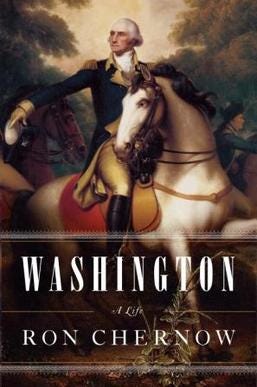
George Washington is my go-to example here. Adams and Jefferson and Franklin and Hamilton were all geniuses. Washington wasn’t. So why are they the knights to his King Arthur? If you read Washington: A Life, you’ll see Chernow struggling to answer that question. Washington was… taller than them?
At least Chernow tries to answer the question! I have similar confusions about Martin Luther King. There was a generation of civil rights leaders before King, Booker T. Washington and A. Philip Randolph and the like. There were King’s rough contemporaries: Roy Wilkins was the head of the NAACP, and Thurgood Marshall was responsible for landmark wins like Brown v Board. Why is King more famous than all of them put together? It seemed to happen instantly. Some no-name 26-year-old pastor is chosen to be the public face of a bus boycott, it goes the 1950s equivalent of viral, and he ends up the most important figure in the entire movement. I don’t get it, and if you read Jonathan Eig’s King: A Life, you won’t either.
What Was Their World Like?
Anytime you read a biography, you learn about the world (or worlds) the subject inhabited. I learned a lot about midcentury politics by reading about J. Edgar Hoover, and even more by comparing it to the overlapping world inhabited by Robert Oppenheimer. But sometimes the world is closer to home. The Worlds I See and The Code Breaker both take place in science academia. But even my cozy little corner of the world is vast, and it’s a lot of fun to see how things differ in biology and artificial intelligence.
Perhaps my all-time favorite experience, just soaking up the milieu, was when I read A Promised Land.
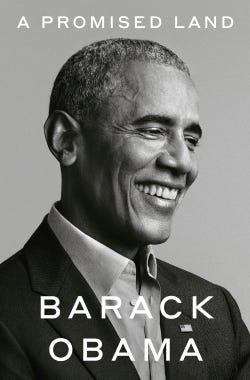
The book covers a small slice of Obama’s political career, mostly from about 2007 to 2011. This was the formative period of my political identity. But my view of events came from watching the Daily Show and talking with other middle schoolers (who, realistically, were getting their political takes from the Daily Show). All of those ideas filtered through eyes not yet quite as sophisticated as the president’s, and then left forgotten for over a decade. Seeing Obama’s early term through his own perspective showed me a world both strange and familiar. The Democrats weren’t a monolith, neither were the Republicans. Obama chooses to see the best in Republicans, praising John McCain in a way that the Mike of 2010 would have found shocking (he does take an extremely dim view of Mitch McConnell).1
Are They The Main Character?
Sometimes you’ll read a biography of someone, and notice they aren’t the protagonist in this story. Sometimes this can be fixed by changing the framing: Washington, Franklin, Hamilton and Lafayette can all be protagonists even if they all occupy the same story. Sometimes, though, there’s no way around the issue.
Martin Van Buren isn’t the main character of 1830s US Politics; Andrew Jackson is. Henry Clay, Daniel Webster, John Calhoun, all loom larger. During Van Buren’s early life, he was overshadowed by New York politicians like DeWitt Clinton and Daniel D. Tompkins. Aaron Burr had cooler sideburns.
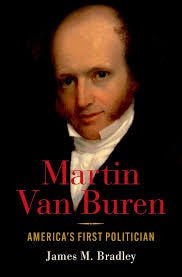
Usually at this point, you should consider switching. Why read about #2 when you can read about #1? But sometimes you’re flying United and the wifi is down and you have nothing but a Van Buren biography to keep you company. And during moments like these, you might start to ponder the fact that you, too, are not the main character.
The Miranda Priestly Angle
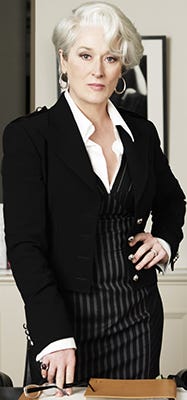
The title character of The Devil Wears Prada occupies a special place in my heart. The fictional fashion editor is demanding and cruel to her subordinates, holds herself to a high standard, and is undoubtedly extremely good at what she does.
This is an archetype that recurs again and again when you read biographies of great men (interestingly, I’ve never read a biography of a female Miranda Priestly). Steve Jobs and Elon Musk are probably the two clearest examples: brilliant perfectionists who will tear your face off if you tamper with their vision. Lyndon B. Johnson is another.
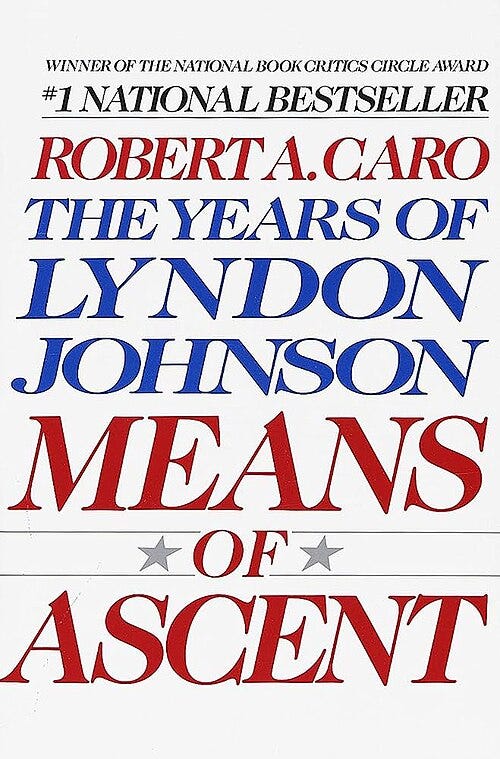
I wonder about Miranda Priestly. Is her abusive behavior a hindrance which drives away talented subordinates, or a motivational tool that drives them to reach new heights? And, if the latter, does that justify it?
I don’t know the answer to those questions. But I can tell you that, at least in LBJ’s case, it was something he could turn on and off at will. When a valuable lieutenant was thinking of leaving, or when he was trying to seduce a woman, he’d be all smiles. As soon as he thought he would get away with it, he was an abusive taskmaster. At least in his case, it wasn’t an involuntary tic. It was something he chose to do because he thought it helped him.
Another weird factoid I picked up from the book: whenever Obama introduces a new character, he always says So-and-so from Such-and-such state. I’ve never found a use for this quirk of his personality, but I’m glad I know about it.